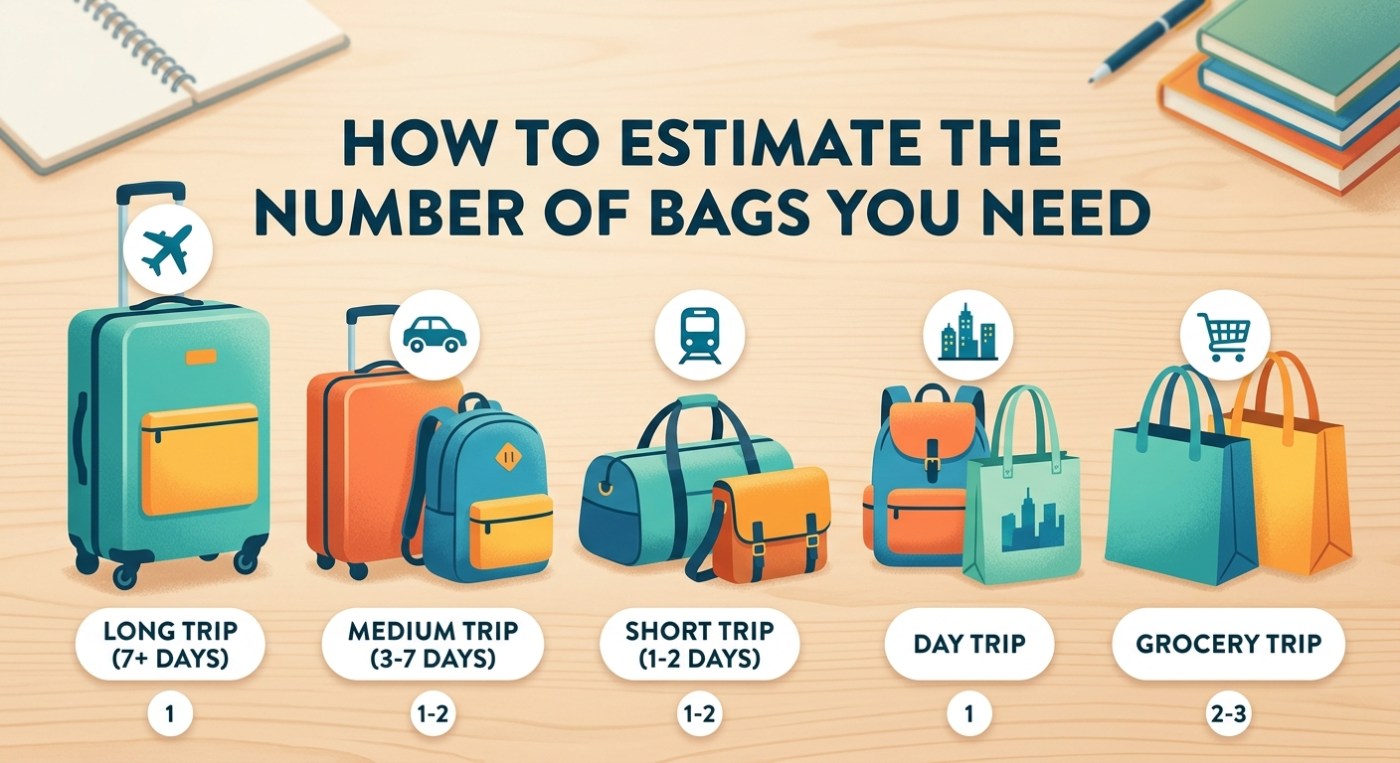
Figuring out how many bags you need for a project sounds easy until you’re standing in a store trying to decide whether you need 10, 20, or 30. The right number depends on what you’re buying, how much each bag holds, the size of the area, and how much material you need.
This comes up in many common jobs. You may need bags of concrete for a post, mulch for a garden bed, soil for raised beds, gravel for a path, or sand for a small building project. Buying too few can leave you with an unfinished job. Buying too many can waste money and leave you with extra material.
The good news is that you don’t need a complex formula. Once you know the volume or weight of material needed and the amount in each bag, you can estimate the number of bags with a simple calculation.
What Does the Number of Bags Depend On?
The first thing to understand is that bag count isn’t based on the area alone. You also need to know the depth or thickness of the material.
For example, covering a garden bed that is 10 feet long and 5 feet wide with a thin layer of mulch takes much less material than filling the same bed with 12 inches of soil.
You usually need four pieces of information:
- Length of the area
- Width of the area
- Depth of the material
- Amount of material in each bag
The units must also match. If your area is measured in feet, the depth should be converted to feet before you work out the volume.
The Basic Formula for Bags
For many bulk materials, you can use this simple process:
Volume needed = Length × Width × Depth
Then:
Number of bags = Total volume needed ÷ Volume per bag
Suppose you have a garden bed that measures 12 feet long and 4 feet wide. You want to add 3 inches of soil.
Convert 3 inches to feet:
3 ÷ 12 = 0.25 feet
Now calculate the volume:
12 × 4 × 0.25 = 12 cubic feet
If each bag contains 1 cubic foot of soil, you’d need:
12 ÷ 1 = 12 bags
It’s smart to round up rather than down. If the result is 12.2 bags, you can’t buy 0.2 of a standard bag, so you’d need 13 bags.
How to Calculate Bags for Different Materials
The basic idea stays the same, but the way you measure the material can change. Bagged products are often sold by volume, weight, or both.
Soil and Potting Mix
Soil is often sold in bags marked by cubic feet. Common sizes include 0.5, 1, 1.5, or 2 cubic feet, though sizes vary by product.
Let’s say you’re filling a raised bed that is 8 feet long, 3 feet wide, and 1 foot deep.
The required volume is:
8 × 3 × 1 = 24 cubic feet
With 1.5 cubic feet per bag:
24 ÷ 1.5 = 16 bags
So you’d need 16 bags.
Keep in mind that soil can settle after it’s placed. If you’re filling a deep bed, adding a little extra can help account for settling.
Mulch
Mulch is also commonly sold by cubic feet. The depth you choose has a big effect on the number of bags.
Imagine a flower bed that measures 20 feet by 6 feet. You want a 3-inch layer of mulch.
Convert the depth:
3 inches ÷ 12 = 0.25 feet
Then calculate:
20 × 6 × 0.25 = 30 cubic feet
If each bag holds 2 cubic feet:
30 ÷ 2 = 15 bags
For a real garden, the amount you need may be a bit higher if the ground isn’t flat or you want a more even finish.
Gravel and Stone
Gravel can be calculated by volume, but bagged gravel is often sold by weight too. A bag might contain 40, 50, or 60 pounds, for example.
When the product is sold by weight, you can’t always divide a cubic-foot estimate by the bag weight. You need the product’s stated coverage rate or bulk density to make a sound estimate.
The product label is your best guide here.
For example, if a 50-pound bag says it covers 0.5 cubic feet, and your project needs 10 cubic feet:
10 ÷ 0.5 = 20 bags
Always use the coverage or volume information from the exact product you’re buying. Two materials with the same bag weight can take up different amounts of space.
Don’t Forget the Depth
Depth is one of the most common sources of error.
A person may measure a patio area correctly but forget that 2 inches, 4 inches, and 6 inches of material require very different amounts.
For example, a 10-foot by 10-foot area has 100 square feet.
At 2 inches deep:
100 × (2 ÷ 12) = 16.67 cubic feet
At 4 inches deep:
100 × (4 ÷ 12) = 33.33 cubic feet
Doubling the depth nearly doubles the material needed.
That’s why measuring all three dimensions, length, width, and depth, matters.
Use a Bag Calculator to Save Time
Manual calculations are useful when you’re checking a small job, but they can become annoying when measurements include decimals or the bag size changes.
A Bag Calculator can make the process much faster. You enter the project measurements and the amount contained in each bag, then use the result to estimate how many bags you’ll need.
A calculator is also helpful when comparing products. For example, one bag may hold 0.5 cubic feet while another holds 2 cubic feet. The number of bags can change a lot even though both products are used for the same type of job.
For one-time projects, using a calculator also reduces the chance of a simple math mistake.
Add a Little Extra for Waste and Settling
Your calculated number is an estimate, not always the exact number you’ll use.
Some material gets lost during handling. Soil can settle. Uneven ground can change the depth. Bags may also contain slightly different amounts depending on the product.
A common approach is to buy a small extra amount rather than ordering the exact calculated figure.
For example, if your calculation gives you 20 bags and your project has an uneven surface, buying 21 or 22 bags may give you a useful margin.
Don’t add a huge amount without a reason. Extra material costs money and may create storage problems.
A Simple Real World Example
Let’s say you’re making a 15-foot by 5-foot garden area and want 4 inches of mulch.
First, convert 4 inches to feet:
4 ÷ 12 = 0.333 feet
Now calculate the volume:
15 × 5 × 0.333 = about 25 cubic feet
Your mulch bags contain 2 cubic feet each.
So:
25 ÷ 2 = 12.5 bags
Because you need whole bags, round up to 13 bags.
If the area is uneven or the mulch may settle, you might choose to buy one extra bag.
This method works for many projects. The key is to keep your units consistent and use the bag size listed by the manufacturer.
Common Mistakes to Avoid
Mixing Inches and Feet
Don’t multiply feet by inches without converting them first. Convert the depth into the same unit as your length and width.
Forgetting to Round Up
If the calculation gives 8.3 bags, buying 8 bags won’t cover the full amount. Round up to the next whole bag.
Using Weight When You Need Volume
A 50-pound bag doesn’t tell you how much space the material takes up unless you know its density or the product’s stated volume.
Ignoring Product Labels
Coverage rates can vary by brand and material. Check the bag or manufacturer’s instructions rather than relying only on a general estimate.
Measuring an Uneven Area as if It’s Perfectly Flat
Real surfaces aren’t always neat rectangles. Sloped or uneven areas can require more material than a basic measurement suggests.
How to Get a More Accurate Estimate
For a better result, measure the area in several places when the ground isn’t level. Take the average depth rather than using the shallowest spot.
It’s also worth checking whether the material is sold by cubic feet, cubic yards, pounds, kilograms, or another unit. You may need to convert between units before calculating the bag count.
If the project is large, use the manufacturer’s coverage guide. Large landscaping, concrete, masonry, and construction jobs often need more careful planning than a small home project.
Final Thoughts
Estimating the number of bags you need starts with one simple idea: calculate how much material your project requires, then divide that amount by what one bag contains.
Measure the length, width, and depth. Keep your units consistent. Check the bag size or coverage rate. Round up to a whole bag, and add a small amount when waste or settling is likely.
Once you know this method, you can use it for mulch, soil, gravel, sand, concrete mixes, and many other bagged materials. A quick calculation before you shop can save you a second trip to the store and help you avoid spending money on far more material than you need.


Leave a Reply